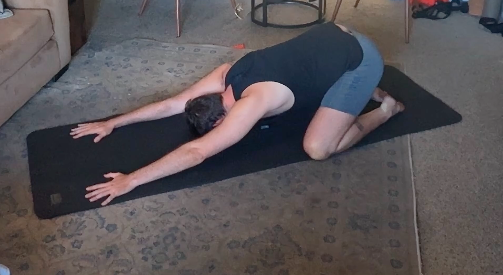
Child’s Pose (Balasana)
Child’s Pose is the place you return to when you need to rest, reflect, or reset. It’s a posture of surrender and grounding. It invites you to fold inward and find safety in stillness. Though often offered as a “break” in active classes, Child’s Pose is far from passive: it teaches you to listen, to breathe, and to reconnect to your center.
The Symbolism of Child’s Pose
Unlike the expansive poses that stretch you wide or challenge your balance, Child’s Pose calls you home. It mirrors the posture of a child curled into safety and trust, reminding you that rest itself is a powerful practice.
In yogic philosophy and, later, in Zen, there is the idea of beginner’s mind. The child symbolizes openness, curiosity, and a lack of ego. Balasana can represent returning to that state. On your Warrior’s Path, that becomes powerful. The warrior must remain teachable.
How to Practice Child’s Pose
1. Find Your Base
Kneel on the mat. Bring your big toes together, and separate your knees (wide or narrow, whichever feels best).
Relax your hips back toward your heels.
2. Fold Forward
Hinge at your hips and fold your torso down between or over your thighs. You can also place a bolster or a pillow under your chest.
Stretch your arms forward, or let them rest back by your heels. You can also bend your elbows and bring your thumbs to the nape of your neck to stretch your triceps.
3. Soften and Rest
Allow your forehead to rest on the mat, a block, or your stacked hands. Rock your head side to side to massage between your eyebrows, which also helps relax your vagus nerve.
Close your eyes and settle your breath.
4. Stay as Needed
Hold for several breaths in an active class, or several minutes in a yin practice.
Props & Modifications
Place a blanket under your knees or shins for comfort.
Use a bolster or pillow under your torso if your hips don’t reach your heels.
Rest your forehead on stacked fists or a block if the floor feels too far away.
Common Misconceptions/Misalignments
Forcing hips to heels: They don’t need to touch. Use props and let gravity work.
Holding tension in your shoulders: Soften your arms, or place them back by your sides.
Thinking of it as “just a break”: It’s also an active practice of breath, surrender, and grounding.
Benefits of Child’s Pose
Physical
Stretches your hips, thighs, and lower back.
Relieves spinal tension.
Calms the body in between stronger poses.
Mental & Emotional
Reduces stress and anxiety.
Invites reflection and inward focus.
Cultivates humility and release.
Cautions & Considerations
Avoid compressing your belly if pregnant. Keep your knees wide and spine long.
Use extra padding if knees or ankles are sensitive.
Skip or modify if you experience sharp pain in your knees or hips.
The Edge Connection
Child’s Pose may look restful, but your edge here is the willingness to stop. To embrace the challenge. To remember what it’s like to be new to the practice, and have a willingness to take the desire to learn along with you as you grow.
We live in a culture that glorifies constant movement. Pausing can feel harder than pushing. In Balasana, your edge is learning to surrender without guilt, to trust the ground beneath you, and to honor rest as part of the path.
Warrior’s Edge Takeaway
In Child’s Pose, you return to the start of the Warrior’s Path. You find that surrender is not retreat but preparation, not weakness but the quiet strength that allows you to rise. You take the willingness to learn and let that carry you forward.